

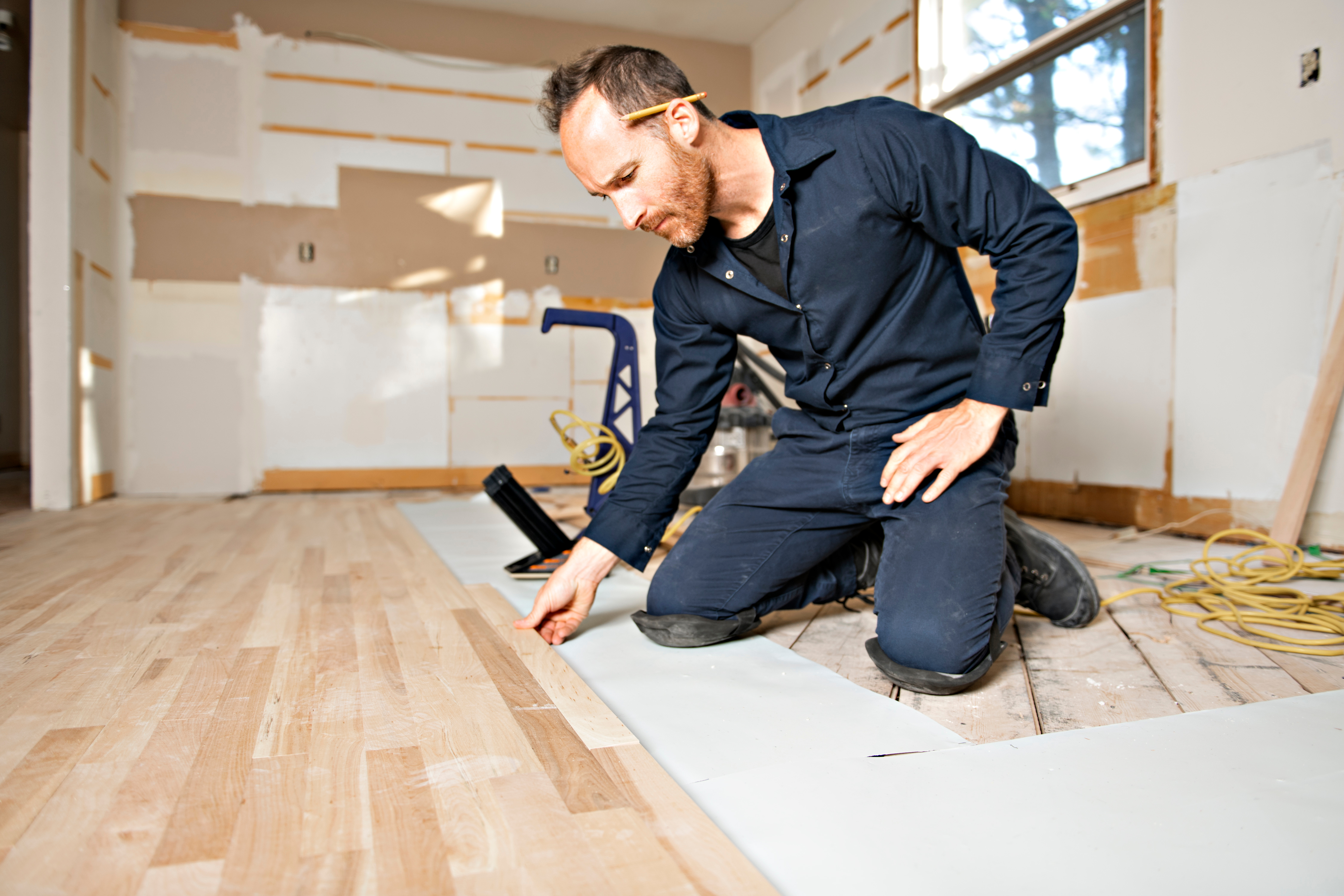
The right way to install luxury vinyl plank depends on your room and how you live in it. Floating planks click together and rest on top of the subfloor, glue-down planks bond to the subfloor with adhesive, and a third option, loose-lay, grips by friction with no glue or clicking at all. Which one fits comes down to five things you can check about your own space: how flat the subfloor is, how big and how sunny the room is, how much moisture is in the slab, how heavy the traffic and rolling loads are, and whether you will ever want to pull the floor back up. We install all three through our vinyl installation team, and you can see the planks themselves in our luxury vinyl catalog. Here is how the methods actually differ and how to match one to your rooms.
What's the Difference Between Floating, Glue-Down, and Loose-Lay Vinyl?
The three methods differ in how the plank connects to the room. Floating vinyl uses a click-lock edge so the planks join to each other and form one connected surface that rests on the subfloor over a thin underlayment, attached to nothing beneath it. Glue-down vinyl is bonded plank by plank to the subfloor with a troweled adhesive, so the floor becomes part of the slab or wood beneath it. Loose-lay vinyl is a heavier plank with a friction-grip backing that holds it in place by weight and grip, without adhesive across the whole floor and without a locking edge, which is why a single loose-lay plank can be lifted and swapped if it is damaged. Each of those three ways of staying put behaves differently once the room heats up, gets wet, or takes a rolling load, and that is what the rest of this comes down to.
How Flat Does the Subfloor Have to Be?
Every vinyl method needs a flat subfloor, and the benchmark comes from ASTM F710, the American Society for Testing and Materials practice for preparing concrete floors to receive resilient flooring. It calls for the slab to be flat within 3/16 of an inch over any 10 feet, along with being permanently dry, clean, smooth, and structurally sound. Glue-down is the least forgiving of a floor that misses that mark, because the adhesive bonds the plank tight to every high and low spot, so a wavy slab shows through as a wavy floor. A floating floor can bridge small dips because it is not stuck down, but big irregularities still telegraph through and can make the joints click or flex underfoot. Loose-lay asks for the flattest, smoothest base of all, since it relies on even contact with the subfloor to grip. On any slab that misses the F710 flatness number, the honest first step is grinding down the highs and filling the lows before a single plank goes in.
Does Room Size Change Which Method You Should Use?
Room size is one of the biggest reasons to choose glue-down over floating. A floating floor expands and contracts with temperature as one connected sheet, so the bigger the field, the more total movement it has to absorb. Manufacturers handle that by requiring an expansion gap around the whole perimeter, commonly around 5/16 of an inch, hidden under the baseboard, and by capping how long a continuous run can be before a doorway transition has to break the floor into separate sections. Rigid cores help here, and the standard behind them, ASTM F3261, tests dimensional stability and resistance to heat, but even a rigid plank still moves as a floating field. Glue-down sidesteps that. Because each plank is anchored, a glued floor doesn't move as a field at all, which makes it the safer choice for large open floor plans, long hallways, and rooms that see wide temperature swings. Keeping the room steady matters either way: the same manufacturers ask that the space stay between 65 and 80 degrees so the floor isn't installed cold and then baked.
Which Method Handles Moisture and Basements Better?
Moisture changes the method more than most people expect, even though the plank itself is waterproof. Glue-down leans entirely on its adhesive, and adhesive is exactly what fails when a concrete slab is too wet, letting the floor bubble or release. A floating floor has no adhesive to fail, so it tolerates a damp slab better, though trapped moisture under any sealed floor is still a mold risk. ASTM F710 settles the question the same way for both: test every slab for moisture regardless of age or grade, and put a moisture vapor retarder under any on-grade or below-grade concrete. The reading itself comes from ASTM F2170, which places probes at 40 percent of the slab's depth (3 of them across the first 1,000 square feet) to measure the humidity inside, or ASTM F1869, which captures the moisture coming off the surface in pounds over a 1,000-square-foot area across 24 hours. In a basement, the slab decides. That one test is the whole ballgame, and we cover the failures it prevents in our piece on subfloor moisture and flooring failures. For below-grade rooms specifically, we also put together a guide to the best luxury vinyl for basement finishing in Northern Colorado.
Which Holds Up Better Under Heavy and Rolling Loads?
Glue-down wins under heavy furniture and rolling loads, which is why it is the default in commercial spaces and rooms full of rolling office chairs. A glued plank can't shift, so a loaded bookcase, a refrigerator, or a wheeled chair rolls across it without dragging the floor or opening a seam. A floating floor is more vulnerable here: a very heavy piece can pin the field so it can't move freely, and the movement then shows up somewhere else as a lifted seam or a slight peak. Loose-lay sits in the middle, held by weight and friction, and it does well in low-to-moderate traffic but can shift under hard rolling loads if it isn't a glued-perimeter installation. For a busy household this rarely rules out floating, but for a commercial floor or a room with real rolling weight, glue-down is the safer call.
Can You Remove or Replace Each One Later?
How easily a floor comes back up is a real deciding factor, especially in a rental or a room you might redo. Floating vinyl is the friendliest to remove, since the planks unclick and lift with no adhesive holding them down, which also makes a damaged board in the middle of the room a bigger job than it sounds. Loose-lay is the easiest of all for spot repairs, because a single plank lifts and a new one drops in without disturbing its neighbors. Glue-down is the permanent option: it holds beautifully for the life of the floor, but taking it up means scraping cured adhesive off the slab, which is slow and messy. If you expect to change the floor in a few years, or you want to be able to fix one plank, that points toward floating or loose-lay before you even look at a subfloor.
Factor | Floating (click) | Glue-down | Loose-lay |
|---|---|---|---|
How it stays put | Planks lock to each other | Bonded to subfloor | Friction backing and weight |
Subfloor flatness needed | Good; bridges small dips | Very flat; shows every flaw | Flattest and smoothest |
Big or sunny rooms | Needs expansion gaps and transitions | Best choice, no field movement | Workable, keep runs modest |
Heavy or rolling loads | Can shift or peak | Best choice | Moderate |
Removal and repair | Unclicks; whole-field repair | Permanent, messy to remove | Easiest, plank by plank |
How Does Northern Colorado Change the Choice?
Along the Front Range, two local realities push the method choice. The first is sun and temperature swing: our bright, high-altitude light pours into south-facing rooms and great rooms, and a big floating field in that kind of room takes on real thermal movement, which is where the expansion gaps and transitions earn their keep, or where gluing the floor down avoids the problem outright. The second is what sits under the floor. Homes in Windsor and Cheyenne are built on basements and on slab-on-grade, and a concrete slab, especially a newer one, can push moisture upward for months, so a below-grade or on-grade room starts with a moisture test and a vapor retarder before anyone decides how the plank attaches. Dry winter air, by contrast, isn't the threat here that it is for solid wood, since vinyl doesn't swell with humidity the way wood does.
Should You Float It or Glue It? A Quick Decision Guide
Glue it down for a big, sunny, or heavy-traffic room on a flat slab; float it for a standard room you might want to change later. The method almost picks itself once you line up the room's conditions, so use this as a starting point and let a measured subfloor and moisture reading confirm it:
Lean glue-down when: the room is large or open, gets strong sun or big temperature swings, takes heavy or rolling loads, sits on a very flat slab, and you want it to be permanent.
Lean floating when: it is a standard residential room, you want an underlayment for warmth and sound, the subfloor has minor irregularities, or you may want to remove or change the floor later.
Consider loose-lay when: you want the easiest plank-by-plank repairs, the subfloor is flat and smooth, and traffic is light to moderate.
Why the Installer Matters More Than the Method
Any of the three methods lasts when it is installed correctly, and any of them fails when the prep is skipped. The subfloor has to be brought flat to the ASTM F710 tolerance, the slab has to be moisture-tested, the planks need to acclimate to the room, a floating floor needs its expansion gaps and transitions, and a glue-down floor needs the right adhesive spread evenly across a clean slab. The core type is a separate decision that runs alongside the method, and we compare it in rigid core versus flexible core LVP. Our crews handle vinyl as in-house work, set to each manufacturer's instructions, so the flatness, the moisture test, and the expansion detail are part of the job rather than an afterthought.
Floating vs. Glue-Down Vinyl Questions We Hear Most
Is floating or glue-down vinyl plank better?
Neither is better on its own; the right one depends on the room. Glue-down suits large, sunny, or high-traffic rooms and very flat slabs, while floating suits standard residential rooms, subfloors with minor dips, and anyone who may want to lift the floor later. Matching the method to the space is what makes the floor last.
Is glue-down vinyl better for large rooms?
Glue-down is usually the better choice for large, open rooms because it doesn't move as a field. A floating floor expands and contracts with temperature across its whole surface, so a big room needs careful expansion gaps and transition strips, while a glued floor is anchored plank by plank and sidesteps that movement entirely.
Does floating vinyl plank need an expansion gap?
Yes, a floating vinyl floor needs an expansion gap around the entire perimeter, commonly about 5/16 of an inch, tucked under the baseboard. The gap gives the floor room to expand and contract with temperature, and skipping it is a leading cause of a floating floor buckling or peaking at the seams.
Which vinyl installation method is best for a basement?
Any of the methods can work in a basement, but the deciding step is the slab moisture test rather than the attachment method. ASTM F710 calls for testing every slab and adding a moisture vapor retarder under below-grade concrete, and a floating floor is often chosen below grade because it has no adhesive to fail if the slab runs damp. Even then, controlling the moisture underneath is what keeps the floor sound.
Can you put heavy furniture on floating vinyl plank?
You can, with a little care, since heavy furniture can pin a floating floor so it can't move freely with temperature. Use wide floor protectors under heavy legs, avoid trapping the floor hard against fixed cabinets, and for very heavy rolling loads consider glue-down instead. Ordinary household furniture is rarely a problem on a properly installed floating floor.
What is loose-lay vinyl, and how is it different?
Loose-lay vinyl is a heavier plank with a friction-grip backing that stays put by weight and grip rather than glue or a click lock. It installs fast, lets you lift and replace a single plank easily, and moves less than a clicked floating floor, but it needs a very flat, smooth subfloor and suits light-to-moderate traffic best.
Which vinyl installation is easiest to remove?
Loose-lay is the easiest to remove, plank by plank, followed by floating, which unclicks and lifts without adhesive. Glue-down is the hardest, because the planks are bonded to the slab and taking them up means scraping off cured adhesive. If future removability matters to you, that alone can settle the method.
Choosing the Right Vinyl Installation in Windsor and Cheyenne
The best installation method is the one that matches your subfloor, your room, and how you live in it, and the difference between the three is less about which plank you buy and more about how it meets the floor beneath it. We help homeowners and businesses across Windsor, Cheyenne, and Northern Colorado weigh flatness, room size, moisture, and traffic, then install vinyl the way the room actually calls for, and flexible financing is available for larger projects. When you're ready, request a free estimate and we'll measure the space, test the subfloor, and match the method to your rooms.


