

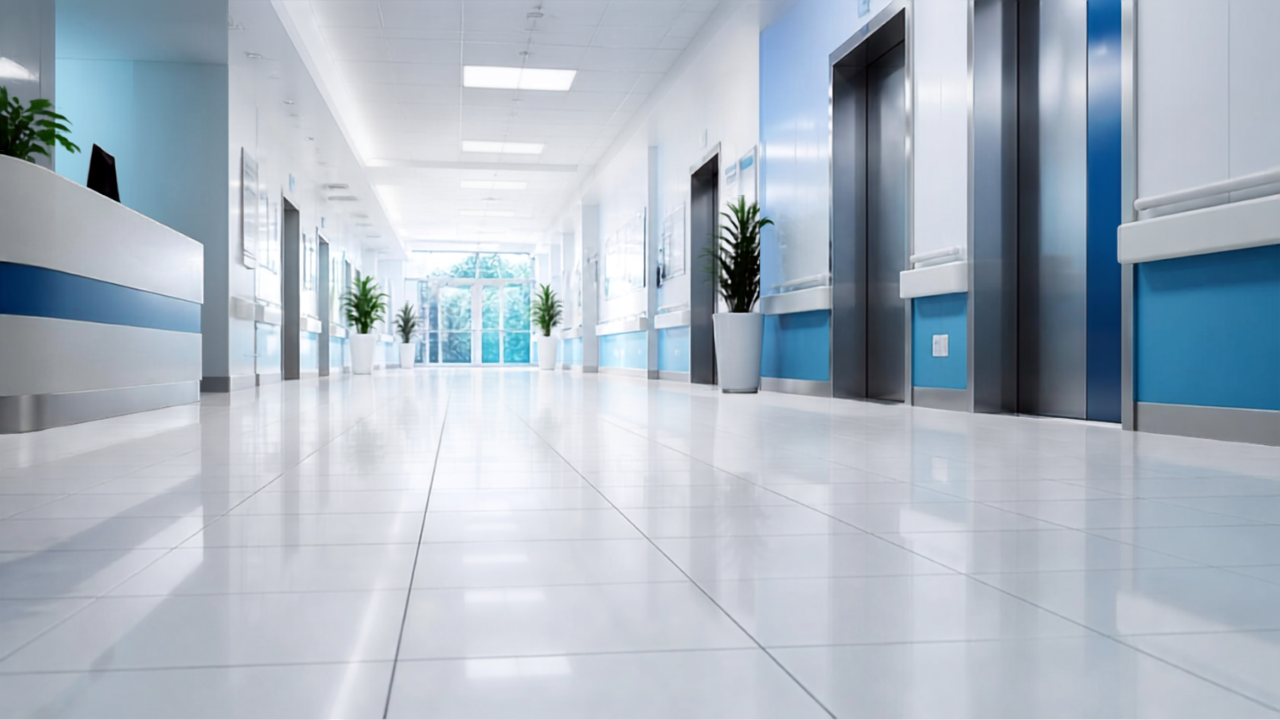
The best commercial tile for a high-traffic or healthcare space is porcelain that clears four numbers at once: an abrasion class high enough for the traffic, a wet slip rating of at least 0.42, a breaking strength of at least 275 pounds, and a grout plan that keeps the floor easy to clean. Every one of those thresholds comes from a published standard, and matching them to the room is what separates a floor that lasts for decades from one that dulls, cracks, or turns slick in a season. We stock commercial-grade porcelain and install it through our commercial flooring team in Windsor and Cheyenne, and these are the specs we go through with a facility manager before anything gets ordered.
What Makes a Tile Commercial Grade?
Commercial grade is a set of measured thresholds, and a tile either passes them or it doesn't. A tile earns the label by meeting the tests in ANSI A137.1, the American National Standard Specifications for Ceramic Tile, published through the Tile Council of North America (TCNA), the trade body that writes and maintains the U.S. tile standards. That standard defines what porcelain is, how well the surface resists wear, how much load the tile can take, and how much grip it keeps when wet. For a busy retail floor or a clinic corridor, those four properties decide almost everything, and a beautiful tile that fails one of them is the wrong tile. Reading each number, and knowing which one matters most for your space, is the whole decision.
Porcelain is the starting point for commercial floors because of how dense it is. Under ANSI A137.1, a tile only counts as porcelain when it absorbs 0.5 percent or less of its weight in water, measured by the ASTM C373 test, which places it in the impervious class. That low absorption is why porcelain shrugs off spilled coffee, daily mopping, and freezing temperatures at an entry: water can't work its way into the body to stain it or expand inside it. The porcelain in our tile catalog is where most commercial projects start, and the more absorbent ceramic tiles stay on walls and in lighter-duty rooms.
How Do You Read a Commercial Tile Spec Sheet?
A commercial tile spec sheet comes down to four numbers, and each one maps to a real risk in the room. The abrasion class tells you how the surface handles foot traffic. The DCOF tells you how the floor grips when wet. The breaking strength tells you how it handles load. The water absorption tells you how dense and stain-resistant the tile is. High-traffic and healthcare floors weight those four differently, and the table sets them side by side.
Spec | What it measures | High-traffic target | Healthcare priority |
|---|---|---|---|
Abrasion class (ASTM C1027) | Surface wear from foot traffic | Class 4 or 5 | Class 4 or 5 |
Wet slip, DCOF (ANSI A137.1) | Grip when the floor is wet | 0.42 or higher | 0.42 or higher in wet areas |
Breaking strength (ASTM C648) | Load the tile takes before cracking | 275 lbf or higher | 275 lbf or higher |
Water absorption (ASTM C373) | Density, stain and moisture resistance | Porcelain, 0.5% or less | Porcelain, 0.5% or less |
Grout | The floor's weak point for cleaning | Fewer lines, sealed | Epoxy grout (ANSI A118.3) |
Which Tile Holds Up Best Under Heavy Foot Traffic?
For heavy foot traffic, the number that matters most is the abrasion class, and you want Class 4 or Class 5. What most people call the PEI rating is really the ASTM C1027 visible abrasion classification, a 0-to-5 scale for how much traffic wears the glaze before the wear shows; the name PEI comes from the Porcelain Enamel Institute rather than the tile industry itself. Class 5 is built for heavy commercial traffic like a mall concourse or a hospital lobby, and Class 4 covers moderate-to-heavy commercial and institutional floors. One honest caveat from TCNA: the test can understate how a tile really wears. Some dark, through-body porcelains that scored as low as Class 2 have shown almost no wear after years of heavy commercial traffic, so the class is a guide, and the tile's construction and color still matter.
Breaking strength is the second traffic number, and for porcelain ANSI A137.1 sets it at 275 pounds of force on average, with no single tile allowed below 250. That is the load a tile takes before it cracks. In practice the floor almost never fails at the tile: one set with full thinset contact on a sound substrate can carry around 400 pounds of concentrated load, so a rolling hospital bed or a loaded pallet jack isn't the problem. An unsupported tile is. Where the installer leaves voids under the tile, or the substrate flexes, even a strong tile cracks, which is why installation matters as much as the spec.
What Does DCOF Slip Resistance Mean for Wet Floors?
DCOF is the wet slip rating, and for any commercial floor that gets wet you want 0.42 or higher. DCOF stands for dynamic coefficient of friction, the grip a floor keeps while a foot is already sliding across it, measured on a wet floor with a standardized tile test. ANSI A137.1 calls for a wet DCOF of at least 0.42 for a level interior floor that will be walked on when wet, which covers entries, restrooms, kitchens, and any clinical area that gets mopped or splashed. This wet-slip method replaced an older static-friction test, ASTM C1028, that used a 0.6 threshold, and the two don't convert to each other, so the only way to know a floor complies is to measure it by the current method. Here is the honest part: 0.42 is a minimum, not a promise. TCNA states plainly that not every tile above 0.42 suits every space, and Daltile, like other makers, is clear that no floor tile is slip proof and that a DCOF number can't tell you whether a slip will happen. Traffic, footwear, and whatever ends up on the floor all change the real risk, so wet-prone spaces should be specced above the minimum.
What Makes Tile Work in Healthcare and Medical Spaces?
In healthcare, the best tile is porcelain with the right wet slip rating and the grout kept to a minimum, because the infection-control question is really about cleaning, and grout is where cleaning gets hard. The U.S. Centers for Disease Control and Prevention (CDC), the federal public-health agency whose guidance hospitals follow, treats floors as low-touch surfaces and has found that disinfecting floors gives no measurable advantage over regular detergent-and-water cleaning against healthcare-associated infections. The CDC also notes that a clean floor doesn't stay clean, since floors recontaminate quickly from shoes, equipment wheels, and the air. So the goal for a medical office or clinic floor is a hard, non-absorbent surface that cleans easily and reliably, day after day. Porcelain's 0.5 percent absorption gives you that non-absorbent surface, and the grout lines are the part that traps soil.
Indoor air quality is the other healthcare consideration, and it comes from the setting materials more than the tile. Tile itself is inert and doesn't off-gas, so the question is what goes under and between it. The certification to ask for is FloorScore, the indoor-air-quality program run by SCS Global Services with the Resilient Floor Covering Institute, which tests flooring, adhesives, and underlayments against California's Section 01350 limits on chemical emissions. Specifying FloorScore-certified adhesives and grout keeps a new clinic floor from adding volatile compounds to the air while the building is occupied, which matters most in spaces treating patients who are already vulnerable.
Honesty helps a healthcare client here more than a sales pitch. For the most infection-sensitive rooms, operating rooms, procedure suites, and some patient rooms, specifiers often choose welded sheet flooring that has almost no joints to trap anything, and tile is the wrong tool for those spaces. Where tile earns its place is the rest of the building: lobbies, corridors, cafeterias, restrooms, entries, and wet areas, where its hardness, its wet slip rating, and its life span beat the alternatives. A good commercial floor plan usually uses both materials and matches each one to the room. You can see finished floors in our project gallery, including larger local jobs like the Mapleton Arts Center and Columbine Commons.
Is Grout the Weak Point in a Commercial Tile Floor?
Grout is the weak point in almost every commercial tile floor, because it is more porous and softer than the tile around it, so it stains, holds soil, and wears at the joints first. Two moves fix most of that. The first is large-format tile, which has fewer grout lines per square foot, so there is less grout to clean and less of it to fail. The second is the grout itself: for a floor that takes spills, chemicals, or heavy cleaning, ask for epoxy grout, which the standards call ANSI A118.3, the specification for chemical-resistant, water-cleanable epoxy grout. Epoxy grout is non-porous, so it resists staining and stands up to the disinfectants and degreasers a commercial kitchen or clinic uses far better than ordinary cement grout. It costs more and it is harder to install well, and it is usually worth it where the floor gets punished.
How Does Northern Colorado's Climate Change the Choice?
Along the Front Range, the climate pushes the choice toward dense porcelain for two reasons: freezing at the doors and dry air inside. A commercial entry in Windsor or Cheyenne sees snowmelt and freezing temperatures cycle across the threshold all winter, and water that soaks into a porous tile or a soft grout joint and then freezes will break it apart over a few seasons. Porcelain's very low water absorption is what makes it frost-resistant, because there is little water inside it to freeze. The other local factor is grit. Sanding trucks, gravel, and tracked-in ice melt act like sandpaper in a busy entry, which is one more reason to specify a high abrasion class and to plan for walk-off matting at the doors. We build these details into commercial jobs across Windsor, Cheyenne, and the wider Northern Colorado market.
Why Installation Decides Whether Commercial Tile Lasts
The best commercial tile fails if it is set badly, so installation decides the outcome as much as the spec sheet does. The breaking-strength number only holds when the tile has full thinset contact underneath, since voids under a tile are where cracks start no matter how strong the tile is rated. A commercial floor also needs the substrate flat and sound, movement joints where the standards call for them so the floor can expand without tenting, and the right mortar and grout for the traffic and chemicals it will see. Our crews handle commercial tile as in-house work, set to each manufacturer's specifications, through our tile installation team, and we take care of the measuring, the substrate prep, and the movement joints as part of the job. If you're weighing whether to hire it out, we've laid out why professional tile installation is worth the investment in more detail.
Commercial Tile Questions We Hear Most
What is the best tile for a high-traffic commercial floor?
The best tile for a high-traffic commercial floor is a Class 4 or Class 5 porcelain with a wet DCOF of at least 0.42. Porcelain's density handles the wear and the load, the abrasion class matches the traffic, and the slip rating keeps entries and restrooms safer when they are wet. Large-format tiles with fewer grout lines make the floor easier to keep clean over its life.
What DCOF do I need for a commercial floor?
For any commercial floor that will be walked on when wet, ANSI A137.1 calls for a wet DCOF of at least 0.42. That covers entries, restrooms, kitchens, and clinical wet areas. Treat 0.42 as the minimum and go higher for spaces that are wet often or see grease, because the standard itself says 0.42 does not suit every situation.
Is porcelain or ceramic better for commercial use?
Porcelain is the better choice for most commercial floors because it absorbs 0.5 percent or less water and takes more load and wear than standard ceramic. Ceramic that absorbs more water is fine for walls and lighter-duty rooms, but commercial floors that see traffic, spills, and constant cleaning are where porcelain's density pays off.
What flooring is best for a medical office or clinic?
For a medical office or clinic, the best floor is a slip-rated porcelain with the grout minimized, paired with welded sheet flooring in the most infection-sensitive rooms. The CDC treats floors as low-touch surfaces that clean well with detergent and water, so the priority is a hard, non-absorbent surface with as few grout joints as possible. Large-format porcelain and epoxy grout get tile most of the way there in corridors, restrooms, and lobbies.
How do you keep commercial tile floors clean?
Commercial tile floors stay clean with routine detergent-and-water cleaning and grout that resists staining. Porcelain itself is non-absorbent, so the maintenance question is almost always the grout: epoxy grout or well-sealed cement grout, plus large-format tile with fewer joints, is what keeps a commercial floor looking new. Walk-off matting at entries cuts the grit that dulls any floor.
Does commercial tile crack under heavy loads or rolling carts?
Properly installed commercial porcelain does not crack under normal rolling loads. A tile that meets the 275-pound breaking-strength standard and is set with full thinset contact can carry around 400 pounds of concentrated load, so carts, beds, and pallet jacks are fine on a sound floor. Cracking almost always traces back to voids under the tile or a substrate that moves, which is an installation issue more than a tile one.
Specifying Commercial Tile in Windsor and Cheyenne
The best commercial tile is the one whose numbers match your space: the abrasion class for the traffic, the DCOF for the wet areas, the breaking strength for the loads, and a grout plan that keeps it cleanable for years. As a member of the Starnet Worldwide Commercial Flooring Partnership, we spec and install commercial tile for high-traffic and healthcare spaces across Windsor, Cheyenne, and Northern Colorado, and we can walk through the trade-offs with you before you commit. Flexible financing is available for larger projects. When you're ready to price a floor, request a free estimate and we'll measure the space, look at how it gets used, and match the tile to the specs that matter.


