

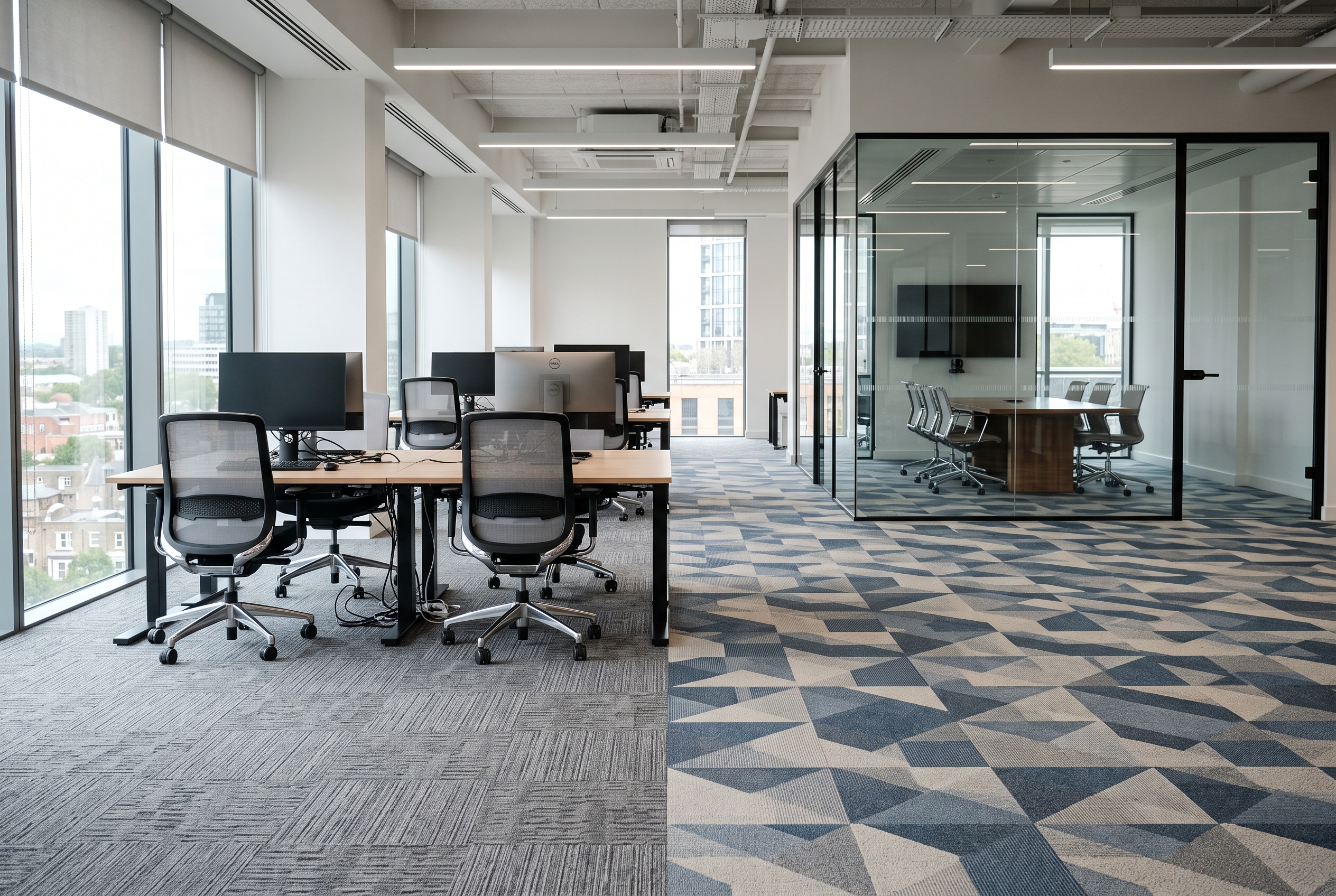
Carpet tile or broadloom comes down to three things: how the space is used and changed, the look it needs, and what installation will involve. Carpet tile wins where spills, worn paths, office moves and raised access floors are part of daily life, because a damaged tile can be lifted and replaced on its own. Broadloom wins where a seamless look, a large-scale pattern or the lowest first cost matters most.
Open offices and tenant suites: carpet tile, because layouts change, cabling moves and one worn or stained area can be fixed without redoing the room.
Schools and training rooms: carpet tile in classrooms and busy halls, where spills are daily and work happens in sections during breaks.
Clinic offices and waiting rooms: carpet tile, with hard surfaces in the clinical rooms.
Boardrooms and executive offices: broadloom, when an unbroken field and a softer feel matter more than spot repairs.
Large open rooms on a tight budget: broadloom, since a wide, simple room uses full rolls with little waste and costs less up front.
Raised access floors: carpet tile, so the panels underneath stay reachable.
| Space | Usually the better fit | Why |
|---|---|---|
| Open offices | Carpet tile | Moves, cabling, spot repairs |
| Tenant suites | Carpet tile | Turnover; spares fit any suite |
| Classrooms and school halls | Carpet tile | Spills; work in sections |
| Clinic offices, waiting rooms | Carpet tile | Swap a stained tile fast |
| Boardrooms, executive offices | Broadloom | Unbroken look, softer feel |
| Large open halls | Broadloom | Joint-free aisles, lower first cost |
| Raised access floors | Carpet tile | Panels stay reachable |
What Broadloom and Carpet Tile Are
Broadloom is carpet made on a roll wider than six feet, most often 12 feet, and installed wall to wall. In commercial spaces it is usually glued to the floor, either directly or over a cushion that is glued down first, because rolling chairs and carts push stretched carpet into ripples. Stretching it over a separate pad on tack strip, the way most homes are done, suits spaces where rolling loads are light.
Carpet tile is carpet with a stiff, stable backing, cut into squares or planks and laid on an adhesive designed to let tiles come back up. The face yarn can be the same as broadloom; the difference is the backing and the format. You can read more about our carpet tile and our broadloom carpet.
Replacing a Stained or Worn Area
Replacing a damaged area is where carpet tile pulls furthest ahead. Lift the damaged tiles, scrape off or seal the old adhesive so the new tiles bond, and set the new ones with their direction arrows pointing the same way as their neighbors. The job takes minutes per tile and the room stays in use.
New tiles can look fresher than the ones around them, since the installed floor has faded and soiled. The fix is to take replacements from a low-traffic spot, such as under desks or in a storage room, and put the new tiles there. Tiles in a worn path can be swapped the same way to spread the wear. That is what attic stock is for: spare tiles from the same production run, kept for exactly this.
Broadloom repairs mean cutting out the damaged area and seaming in a patch cut from a remnant. In a quiet corner it can disappear; in a busy aisle or in raking light it usually shows. A large stain or a worn traffic lane in broadloom often means replacing the whole room.
Seams, Patterns and the Look You Want
Broadloom gives the unbroken look and carpet tile gives flexibility, so the look you want is the second thing that decides it. Broadloom can carry a large pattern or a border across a room without joints. It still has seams where rolls meet, and the seam plan is part of a good installation.
A good seam plan keeps seams to a minimum and runs them the length of the room, with traffic moving along them. Seams stay out of raking light from windows and away from spots where people pivot, and never run perpendicular to a doorway.
A patterned broadloom also has to line up at every seam. A large pattern repeat takes extra material to match, which adds to the waste in a patterned room.
Carpet tile shows a grid of joints, strongest in solid colors and nearly invisible in textured or patterned styles.
The way tiles are laid changes the look as well. Monolithic installation turns every tile the same way for a broadloom-like field. Quarter-turn rotates each tile for a checkerboard texture, and ashlar or brick layouts offset the rows. Tile also makes it easy to color-code zones, mark a path or add a logo, and our post on carpet tile designs shows more.
Furniture, Access Floors, Waste and the Installation Schedule
Installation is often where the decision is really made, because it decides how long a space is out of use. Broadloom needs a cleared room, a path for full-width rolls to get in, and time to lay out, seam and glue. A glued broadloom floor then needs traffic kept off for a day or two while the adhesive cures, and no wet cleaning for about a month.
Carpet tile arrives in cartons that fit in any elevator, and it goes down section by section. Office furniture and cubicle panels can often be lifted in place with jacks while tiles go underneath. Done that way, an office can often be recarpeted in a single overnight shift. On raised access floors, tile seams are offset from the panel seams so the panels can still be lifted.
Waste favors tile in narrow or irregular rooms. Broadloom comes in fixed widths, so a room that is not a multiple of the roll width leaves offcuts, while tile is cut only at the edges. Both formats need a dry, flat slab. Carpet and adhesive acclimate on site for at least a day, and concrete is tested for moisture against the maker's limits before anything is glued.
On a job with other trades, carpet goes in last, or it gets covered with breathable paper to protect it. After a tile installation, a quick check shows whether it went in right: ten tiles in a row should measure ten tile widths, within about a quarter inch, with no gaps or peaks. For keeping a building running during the work, see our post on planning commercial floors around downtime.
Cost Up Front and Over the Years
Comparable broadloom usually costs less per square foot up front, and carpet tile often costs less over the life of a busy floor. Tile's product and installation cost more, and the disruption it saves may make up the difference on an occupied floor. In narrow or oddly shaped rooms, broadloom's waste narrows the gap, while in a big, simple rectangle its lower first cost stands.
Over the years, the difference is what happens when part of the floor wears out. With tile you replace a few squares, and with broadloom you often replace the room. Our post on commercial flooring life-cycle costs shows how to weigh first cost against maintenance and replacement. We price both formats for your space at the estimate.
What Makes High-Traffic Commercial Carpet Last
How long commercial carpet lasts in heavy traffic depends more on how it is built than on its format. Look for a dense, low pile, usually a level loop or a tight cut pile, and a maker's appearance retention rating matched to your traffic. Nylon is the usual fiber for heavy commercial traffic, because it is durable, resilient and stands up to wet cleaning, while polyester belongs in lighter-traffic rooms.
The same construction wears the same on a roll or in tiles; tile simply lets a worn area be replaced without the rest. Rolling chairs and carts need a firm base, so a hard-backed tile or a glued broadloom holds up best to casters, with chair mats at the busiest desks.
Carpet on an accessible route has its own limits under the ADA standards. It has to be fastened to the floor with a firm backing, a firm pad or no pad, kept to half an inch of pile or less, and finished with trim wherever an edge is exposed. Our guide to commercial flooring for high-traffic areas compares carpet with the hard-surface options.
Comfort, Cushion and Sound
Carpet tile needs no separate pad, because its backing does that job, and both formats absorb far more footfall noise than hard floors. Cushion-backed tile, or broadloom over a glued cushion, feels softer underfoot and quiets a room more than a hard-backed tile. For open offices where sound is the main concern, our post on acoustic flooring for open offices goes deeper.
Cleaning, Spills and Winter Grit
Both formats are cleaned the same way: regular vacuuming, spills blotted up right away, and extraction cleaning on a schedule, before soiling shows. The difference comes after a bad spill. A stained tile can be lifted and replaced, while a stained broadloom area has to be cleaned out or patched. Backing plays a part, and Mannington Commercial says a vinyl-backed carpet keeps a spill in the fiber layer so it does not soak through to the floor.
Most soil arrives on shoes, and here it arrives with snow, sand and magnesium chloride from the roads. The Carpet and Rug Institute recommends 12 to 15 feet of entry matting for an office building, and more for the busiest ones, which protects either format. Entrances are also the first place to plan for spare tiles or a replaceable section.
Which Format Fits Each Kind of Space
Carpet tile fits most offices, schools and clinics, and broadloom fits formal rooms and large open halls, but the reason differs from one space to the next.
Open Offices and Tenant Suites
Carpet tile is the better fit for open offices and tenant suites. Layouts change, cabling and power move, and tenants turn over. Spare tiles from the same run fit any suite in the building, and one damaged area never forces a whole-floor replacement.
Private Offices, Boardrooms and Executive Suites
Broadloom suits boardrooms and executive offices when an unbroken look and a softer feel lead. Choose tile instead when the suite should match the open office around it, or when the room will be rearranged often.
Schools and Training Rooms
Schools and training rooms usually do best with carpet tile in classrooms and halls, which take spills every day and get their maintenance in sections over breaks. Broadloom still fits a library or an auditorium, where the room is large and simple and the look matters.
Clinics and Medical Offices
In a clinic, carpet tile is the right carpet for offices and waiting rooms, because a stained square can be replaced the same day without closing the room. Exam rooms and other clinical areas take hard surfaces, which our guide to commercial flooring for healthcare facilities covers.
Churches, Event Rooms and Hotels
Large open rooms, sanctuaries and event halls often suit broadloom, because long aisles look best without joints and wide rooms use full rolls efficiently. Hotels mix both, with broadloom or tile in corridors and carpet in meeting rooms, depending on how much the brand wants a continuous pattern.
Using Both in One Building
Many buildings use both: broadloom in the boardroom and the executive suite, carpet tile in the open office and corridors. Keep the finished heights matched where they meet, use a proper transition, and choose colors that coordinate, since tile and broadloom from different lines will not match exactly.
Ripples, Curling Tiles and Other Problems
Ripples in broadloom, lifting tile edges and a checkerboard look are the common commercial carpet problems, and each traces to a cause you can check:
| Problem | Likely cause | Fix |
|---|---|---|
| Ripples in broadloom | Stretch-in under rolling loads, or glue failure | Relay glued down |
| Peaked seams | Power stretching on a stretch-in job | Reseam, or glue down |
| Tile edges lifting | Thin adhesive at doors and corners, moisture | Re-adhere; test the slab |
| Checkerboard look | Mixed lots or tile direction | Relay by lot and arrow |
| Crushed traffic lanes | Pile too light for the traffic | Rotate or replace tiles |
Ripples in broadloom are the classic failure. On a stretch-in job they usually mean the carpet was not stretched tight enough, or rolling loads worked it loose. On a glued job they mean the adhesive let go, sometimes because moisture came up through the slab, and swings in humidity and temperature make both worse.
Tile edges tend to come loose first at door jambs, thresholds and corners, where adhesive coverage needs the most care. A checkerboard look in tile usually means tiles from different production lots were mixed, or the direction arrows on the backs were not followed. Repair in sections when the problem is local, and replace when the backing is coming apart across the room.
Choosing and Installing Commercial Carpet With Us
Whoever installs your commercial carpet, look for a contractor that carries both formats and measures and draws the space before quoting. The same contractor should plan the seams or tile direction on paper, test the slab, and order attic stock from the same run as the floor.
At Masters Petersens Flooring & Interior Design, we carry both carpet and carpet tile and install both with our own commercial crews. Commercial flooring and installation is one of our services, and we are a member of the Starnet Worldwide Commercial Flooring Partnership. For carpet installation, we handle on-site measurement, removal of the old flooring and the installation, with in-house installers trained to manufacturer specifications.
Every commercial job we take on moves through the same stages, from award and submittal to procurement, scheduling, installation and closeout. A project manager and field superintendents follow each job, and materials acclimate in our conditioned warehouses before delivery. You can read more about our commercial team.
Other Questions About Commercial Carpet
How Much Extra Carpet Tile Should You Order?
Order the installation allowance plus attic stock from the same production run. The University of Arizona's design standards, for example, ask for 5 percent of the main field tile and 10 percent of each accent color as attic stock, wrapped and labeled. Store it flat indoors so it matches when you need it.
Can Carpet Tile Go on Stairs or Over Existing Carpet?
No, carpet tile does not go over existing carpet, and stairs usually take broadloom or treads made for stairs, since a flat tile does not wrap the nose of a step. Tile can go over some old hard floors that are well bonded and clean.
Is Carpet Tile Glued Down?
Yes, carpet tile is usually glued down with a thin film of pressure-sensitive adhesive that keeps tiles from sliding but lets them come up for replacement. Some tiles come with the adhesive already applied, and some systems use connectors in its place.
How Long Does Installation Take?
Installation takes at least a day before any carpet goes down, because the carpet and adhesive acclimate on site first. After that, the time depends on the area, the prep and how much furniture has to move. Glued broadloom then needs a day or two with only installers walking on it before the space opens.
Getting a Commercial Carpet Estimate
The right format for your space becomes clear once someone walks it with your floor plan in hand. Request a free estimate to meet with one of our project specialists, and we will measure the space and price the options you are weighing so you can decide.


