

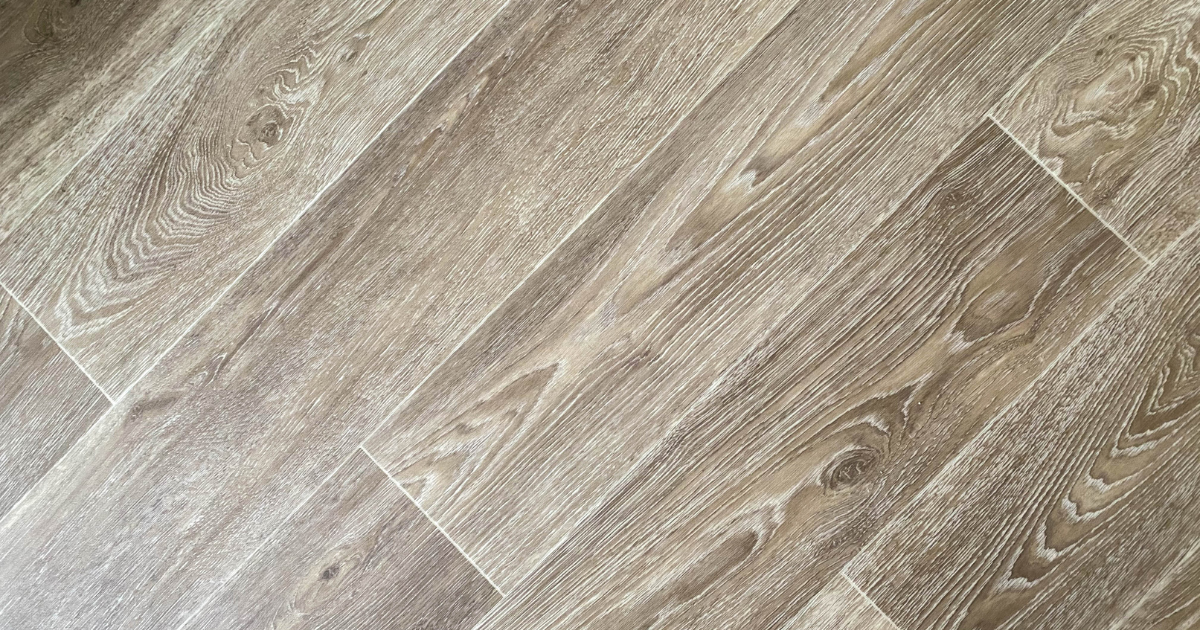
Luxury vinyl plank is waterproof at the plank, and that is the part the label is telling you about: the rigid core doesn't absorb water or swell, so a spilled glass, a mopped floor, or a pet accident sitting on the surface does no harm. What the word leaves out is the rest of the floor. Waterproof describes the plank, not the whole installed system, and water still reaches the seams between planks and the subfloor underneath. Knowing where that line falls is what keeps a waterproof floor from failing in the one way its name seems to rule out. You can see the range in our luxury vinyl catalog, and we install it, so this is the conversation we have with customers before a single box is opened.
Is Luxury Vinyl Plank Actually Waterproof?
The plank itself is genuinely waterproof, because its core is a rigid polymer that doesn't take on water the way a wood or a laminate fiberboard core does. That core is what changed vinyl from water-resistant to waterproof, and it is the reason LVP ended up in kitchens, baths, and basements. But waterproof is not a graded score you can compare between two floors. The standard that governs these products, ASTM F3261, the American Society for Testing and Materials specification for rigid-core resilient flooring, checks things like residual indentation, dimensional stability, resistance to heat, light, and chemicals, and static load, and it has no waterproof test in it at all. Waterproof is a property of how the plank is built, so the honest way to read the word is as a yes-or-no about the plank, and nothing more. If you want specific products compared, we lined up the leading brands in our guide to top waterproof flooring brands.
What Does "Waterproof" Actually Cover on Luxury Vinyl?
Waterproof on a luxury vinyl plank covers the plank standing up to water from above, and it stops there. Spills, tracked-in snow, a leaking dishwasher caught in time, mopping, humidity, a puppy in training: none of that hurts the plank, and that is a real advantage over wood and laminate. What the rating does not cover is the water that gets past the surface. It says nothing about the subfloor beneath the planks, nothing about the seams and edges where planks meet, and nothing about standing water that finds a way underneath and has nowhere to go. The table below sorts the two, because most of the confusion about waterproof flooring lives in the gap between them.
What waterproof LVP covers | What it does not cover |
|---|---|
Spills, mopping, and pet accidents on the surface | Moisture rising up through a concrete subfloor |
The plank not swelling or absorbing water | Water wicking down into the seams and edges |
Humidity and everyday splashes | Standing water that gets trapped under the floor |
Wet-mop cleaning the plank can't wick up | Mold or rot in the subfloor below the planks |
Where Does a "Waterproof" Vinyl Floor Actually Fail?
A waterproof vinyl floor fails at the seams and from below, almost never at the plank face. Click-together planks lock tightly, but the joints are not a sealed, welded surface, so a large or lingering spill, especially at a perimeter, a threshold, or around a toilet or tub, can wick down between the planks and spread across the subfloor. The plank on top looks perfect. Underneath, water is now trapped against a wood or concrete subfloor with no way to dry, which is exactly the condition that grows mold and mildew and rots a wood subfloor over time. The second failure comes from the other direction: moisture pushing up out of a concrete slab. Either way, the damage is under a floor that still reads as waterproof from above, which is why the failures surprise people. We wrote about how these hidden failures start in subfloor moisture and flooring failures.
Why Subfloor Moisture Still Matters Under Waterproof Vinyl
Subfloor moisture matters under waterproof vinyl precisely because the plank is waterproof: it seals the slab, so whatever moisture the concrete gives off is trapped against the underside of the floor. Every concrete slab holds and releases some moisture, and a new slab releases a lot for months as it cures. Sealed under vinyl, that vapor breaks down glue on a glue-down floor, can delaminate an attached pad, and feeds mold in the dark, damp space it creates. The way to know a slab is dry enough is to test it. ASTM F2170 reads the relative humidity inside the concrete with a probe set at 40 percent of the slab's depth, which is the level that predicts how wet the slab will be once a floor seals it. A proper test is systematic: F2170 calls for three probe locations in the first 1,000 square feet and one more for every additional 1,000, and each probe has to sit at least 24 hours before it gives a reading worth trusting. A companion test, ASTM F1869, measures how much moisture is actually coming off the surface, in pounds over a 1,000-square-foot area across 24 hours, and it applies to below-grade, on-grade, and above-grade slabs alike. There is no universal pass mark: the humidity a floor can tolerate depends on the product, the manufacturer, and the adhesive, so the reading gets checked against the specific plank's instructions.
SPC vs WPC: Does the Core Change How Waterproof It Is?
Neither SPC nor WPC is more waterproof than the other, because both rigid cores are waterproof by construction; what differs between them is feel and toughness. SPC, a stone-plastic composite, has a solid, dense core with no foam in it, which makes it harder, thinner, and more resistant to dents and to the expansion that heat and sunlight can cause. WPC, a wood-plastic composite, adds an intentional foam structure to the core, which makes the plank a little thicker and softer and warmer underfoot at the cost of some dent resistance. The choice between them is a comfort-and-durability decision, and it runs alongside a separate choice between a rigid click floor and a flexible glue-down one, which we compare in rigid core versus flexible core LVP.
Core | Structure | Feel underfoot | Best where |
|---|---|---|---|
SPC (stone-plastic composite) | Solid, dense, no foam | Firmer, thinner | High traffic, sunny rooms, dent resistance |
WPC (wood-plastic composite) | Foamed, cellular core | Softer, warmer | Comfort underfoot, quieter rooms |
Waterproof Does Not Mean Scratch-Proof
Waterproof says nothing about scratches and dents, which are handled by a different part of the plank entirely. The wear layer is the clear top coat that takes the daily abuse, and its thickness, counted in mils, or thousandths of an inch, is the number that decides how well the floor resists scratches, scuffs, and traffic wear. A floor can be fully waterproof and still scratch if the wear layer is thin, so a waterproof claim and a durability claim are two separate questions to ask about the same plank. We break down how to read that number in our guide to LVP thickness and wear layers.
How Does Northern Colorado Change the Waterproof Question?
Along the Front Range, the threat to a waterproof floor comes from the slab underneath rather than the dry indoor air. Homes in Windsor and Cheyenne sit on concrete in basements and on slab-on-grade, and that concrete can push moisture upward from a freshly poured slab that is still curing, from spring snowmelt working through the ground, or from seasonal humidity condensing against cool below-grade concrete. The plank will shrug off a spill from above and still be undermined by that moisture from below if nobody checks the slab first. This is why a below-grade LVP job here starts with a moisture test and, where the reading calls for it, a vapor barrier under the floor. We put the below-grade specifics together in our guide to the best luxury vinyl for basement finishing in Northern Colorado.
Getting a Waterproof Floor Installed So It Stays Waterproof
A waterproof floor only lives up to the word when it is installed for the water it will actually meet. That starts with testing the subfloor and adding a vapor barrier when the slab reading calls for one, so moisture from below never gets its chance. It means leaving the expansion gap the plank needs around the edges, since a rigid floor that can't move will lift at the seams and open the joints water wicks into. And it means planning the perimeter and the wet-area transitions, around tubs, showers, and toilets, where most under-floor water actually starts. Our crews handle vinyl as in-house work, set to each manufacturer's instructions, through our vinyl installation team, and the slab test and the vapor barrier are part of the job rather than an upsell.
Waterproof Vinyl Plank Questions We Hear Most
Is luxury vinyl plank completely waterproof?
The plank is waterproof, but the installed floor isn't automatically. The rigid core won't absorb water or swell, so surface spills are no problem, yet water can still reach the seams and the subfloor, and moisture can rise from a concrete slab below. Treat the waterproof claim as being about the plank, and treat the subfloor and the seams as separate questions.
Can you install waterproof vinyl plank in a basement?
Yes, waterproof vinyl plank is one of the better basement floors, as long as the concrete slab is tested for moisture first. Basements sit against cool concrete that can give off moisture, and a waterproof plank will trap that moisture underneath if the slab isn't dry enough or protected with a vapor barrier. A moisture test before installation is what makes the difference between a floor that lasts and one that fails from below.
Does waterproof vinyl need a moisture barrier over concrete?
Often yes, depending on what the slab moisture test shows. A vapor barrier keeps moisture from a concrete slab from reaching the underside of a waterproof floor, and whether you need one comes down to the ASTM F2170 or F1869 reading and the plank manufacturer's limit. Skipping the test is how the barrier decision gets made wrong.
Can water get under vinyl plank flooring?
Yes, water can get under vinyl plank flooring through the seams, especially from a large or lingering spill at a perimeter, a threshold, or a bathroom fixture. The planks lock tightly but the joints are not a sealed surface, so water that pools long enough can work its way down and get trapped against the subfloor. Wiping up standing water promptly and sealing wet-area perimeters during installation are what keep that from happening.
Is SPC or WPC more waterproof?
Neither is more waterproof, since both rigid cores are waterproof by construction. SPC has a solid, dense core that is harder and more dent-resistant, while WPC has a foamed core that feels softer and warmer underfoot. The decision between them comes down to comfort and dent resistance rather than water.
Does waterproof vinyl plank scratch or dent?
A waterproof plank can still scratch or dent, because that is controlled by the wear layer, which is a separate part of the plank from the waterproof core. The wear layer's thickness, measured in mils, is the number that governs scratch and wear resistance, and a thin one will scratch even on a fully waterproof floor. Ask about the wear layer separately from the waterproof claim.
Can mold grow under waterproof vinyl?
Mold can grow under waterproof vinyl when moisture gets trapped beneath it, which is the main reason the subfloor matters so much. A waterproof plank seals whatever is underneath, so water from a slab or from a spill that reached the seams sits in the dark with nowhere to dry. Controlling subfloor moisture and cleaning up standing water are how you keep the space under the floor dry.
Choosing Waterproof Vinyl in Windsor and Cheyenne
Waterproof vinyl plank earns its name at the plank, and it earns it across the whole floor only when the subfloor is tested, the seams and wet areas are planned, and the plank is matched to the room. That is the difference between a floor that shrugs off real life and one that fails quietly from underneath. We help homeowners and businesses across Windsor, Cheyenne, and Northern Colorado choose and install luxury vinyl that holds up, and flexible financing is there for larger projects. When you're ready, request a free estimate and we'll test the space, talk through how each room gets used, and match the floor to it.


